
DNF Diaries: Why White Lights by Lauren Kate Lost Me
We may earn money or products from the companies mentioned in this post.
There are books that lose me immediately, and then there are books that keep giving me enough to make me stop and think, “Okay, maybe the train is on the tracks.” White Lights by Lauren Kate somehow managed to be both.
The premise is intriguing enough. Dez has always wanted to make movies, but before she gets anywhere near applying for film school, or even the mysterious halls of Acheron, the elite film school at the center of the story, her life implodes.
A violent encounter leaves her brother hospitalized. Dez, in turn, finds herself under suspicion, and then Rafe de la Cruz appears, offering her an escape and an invitation to a film school she’s never even heard of. From there, what looks like an opportunity to finally pursue the future she wants starts opening into something much stranger. An otherworldly conflict involving filmmaking, angels, death, power, and a school whose purpose is much bigger than making movies.
There is a LOT here that should have worked for me.
A mysterious school? I’m listening.
Ancient supernatural mythology? Keep talking.
A strange filmmaking concept tied to something much larger than the students understand? Okay, I am hooked like a fish.
Unfortunately, White Lights almost lost me before I ever got to any of it.
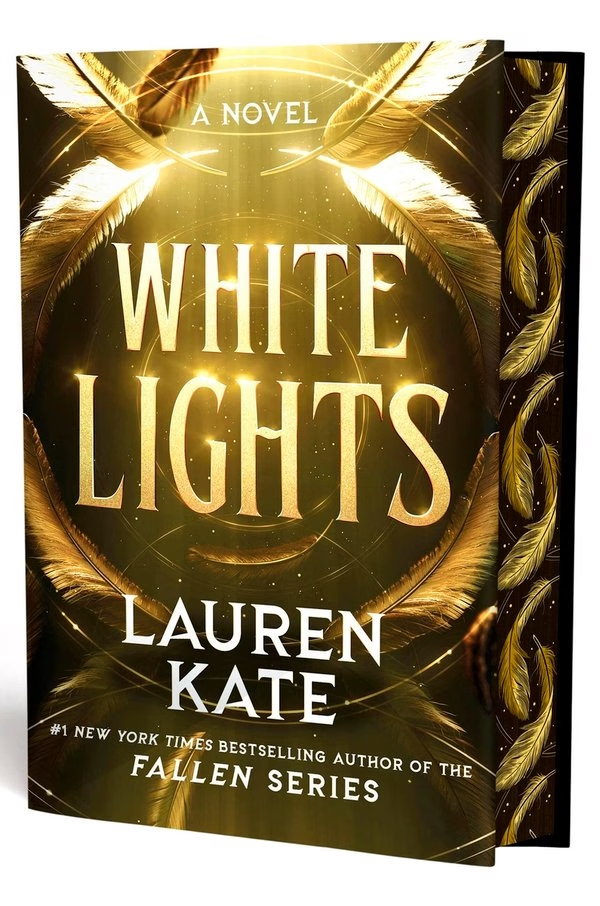
Title: White Lights (White Lights, 1)
Author: Lauren Kate
Publisher: Grand Central Publishing
Format: Physical
Genre: Fantasy, Romantasy, Dark Academia, Angels, Romance
Release Date: June 4, 2026
Pages: 416
Star Rating: DNF @ 45%
Spice Rating: 0 chili pepper (to the point of DNF)
The First Twenty Pages Were a Struggle
There is an armed robbery very early on in White Lights, and this was the first moment where the book and I started fighting. Dez is working when a gunman enters. During the confrontation, she manages to pluck out his eyeball.
His actual eyeball. The man yelps, then goes still.
Okay, sure, fine.
We’re already asking quite a lot of me, but let’s continue.
The gunman is still armed. He has a gun pointed at Dez and watches her as she moves across the room toward the deep fryer. The narrative specifically acknowledges that he’s following her movements with the gun.
But, he doesn’t shoot.
Dez reaches the fryer, pulls out the basket of hot oil, and manages to hurl it toward him. Her brother, who had previously been knocked down after being kicked in the groin, manages to get up, cross the necessary distance, and step between them in time to take the hot oil instead.
And I stopped. Because now I have questions.
Not because I can’t suspend my disbelief. I read fantasy for fuck’s sake. I will believe in dragons, immortal beings, impossible magic systems, and six-thousand-year-old angels without thinking twice about it. The impossible isn’t the problem of it all.
The problem is when the actions happening in the scene don’t seem to obey their own sense of time and consequence.
A man has just had his eye ripped out of its socket. He’s armed. He’s alert enough to track Dez’s movements through the space with his gun. She’s moving toward something that could be used as a weapon.
Her brother is incapacitated on the floor. And somehow, somehow everyone has exactly as much — or as little— time as the next dramatic moment requires. I wasn’t immersed in the robbery anymore. I was trying to choreograph it. And honestly, choreography is the last thing I want to be doing while I am reading (at least not this kind). And that’s what happens throughout the entire story. I could see the walls moving around the story.
Your TBR is Too Long for Mediocre Books. join my newsletter
I Could See the Plot Working
This became the problem I couldn’t shake while reading White Lights. All stories are constructed. Of course they are. Authors are constantly arranging circumstances to move characters where they need to go. Someone misses a train because the author needs them to meet someone at the station. A door closes because another needs to open. A character makes a mistake because that mistake creates the conflict.
That’s storytelling.
The trick is making me FORGET you’re doing it. And I kept remembering. Too often, it felt as though White Lights knew the next plot point it needed to reach and then created whatever circumstances were necessary to push Dez there. The robbery needs to change her life. Her brother needs to be removed from the equation. Rafe needs to become the only option.
None of those things are inherently problems. But I could feel the machinery moving underneath them. Instead of action leading naturally to reaction and reaction creating the necessary consequences, the cause and effect sometimes seemed flexible depending on what the story needed next.
That distinction became incredibly important to my experience with this book. I wasn’t struggling to believe in the supernatural world. I was struggling to believe the physical and emotional reality surrounding it all.
And Then White Lights Got Better
Here’s where this review gets a little…complicated.
Because after that opening? The book actually gets better. Once Dez reaches Acheron and the larger story begins revealing itself, White Lights settles down. The plot smooths some of its bumps. Threads that initially felt disconnected begin connecting. The story finds a rhythm. I stopped feeling quite as though I had been dropped into a clusterfuck and told to find my own way out.
And the supernatural mythology started giving me something much more interesting to grab onto. Pieces interested me, and suddenly there were larger questions about mortality, power, desire, and what happens when beings who have existed outside ordinary human experience begin wanting things that are profoundly human. And Acheron itself became more interesting as the filmmaking component started intertwining with that supernatural world.
This was the point where I started thinking maybe I’d been too worried about the opening. Maybe, just maybe, White Lights simply had a rough beginning. Maybe this was one of those books where you have to wade through the chaos until suddenly all those loose threads start connecting to each other.
Because once they did, I could see the story Lauren Kate was building. But I still kept running into moments that made me stop and think:
Huh??
You Don’t Need More Books. You Need the Right Ones. Join My Newsletter.
My Other Problem Was Dez
I don’t like her. And I tried. The farther I got into the book, the more I found Dez to be a whiny, juvenile and frustrating brat. There were moments when her motivations didn’t make sense to me. There were other moments when her reactions irritated me. And eventually I started having the same thought whenever she began complaining:
Girl, SHUT UP.
That’s not necessarily a death sentence for a book. I don’t need protagonists to be likable. Some of my favorite characters are terrible fucking people. Give me selfish, impulsive, morally questionable. You can even give me a character making decisions so spectacularly bad that I’m yelling at the page.
But make me care about watching them do it. That’s the part I never developed with Dez. And without that attachment, all of the mysteries surrounding her started losing some of their power.
The Strange Thing Is, White Lights Isn’t Bad
This might be the hardest part of explaining why I stopped reading it. I don’t think White Lights is badly written. The prose is fine. Once the opening chaos settles, the pacing is adequate. It isn’t moving so quickly that nothing has room to breathe, and it isn’t dragging so badly that I was bored because nothing was happening. The mythology has some genuinely interesting pieces.
Acheron is interesting. The filmmaking concept is interesting. The supernatural conflict is interesting. There were even points when I could imagine myself reading the second book. But there was nothing pulling me back. I’d put White Lights down and essentially forget about it.
I wasn’t thinking about Rafe. I wasn’t wondering what was really happening at Acheron. Wasn’t even wondering when I’d have enough time to sneak in another chapter. The book was sitting there. And I was perfectly content to let it sit there.
Eventually I looked at my progress, and somewhere around the 45% mark, I realized what the actual problem was.
I didn’t care enough to continue. That’s it. Not rage. Not hatred. And not some spectacular literary catastrophe.
Absolute indifference. And for me, indifference is sometimes harder for a book to overcome than hatred. At least when I hate something, I am feeling something.
Why I DNF’d White Lights
At approximately 45%, I stopped. There are too many books I desperately want to read for me to spend another 200 or so pages waiting for myself to become emotionally invested in one that hasn’t managed it nearly halfway through.
And ultimately, that’s what a DNF means for me.
It doesn’t necessarily mean the book is objectively terrible. It means the book stopped earning my next page. White Lights had almost half of the novel to make me need to know what happened next.
It didn’t.
The visible plot mechanics certainly contributed. So did my frustration with Dez. So did those moments when the story asked me to accept actions without giving me a believable chain between action, reaction, and consequence. But underneath all of those individual criticisms was something much simpler: I didn’t care what happened next. And once I realized that, continuing felt less like reading and more like completing an obligation.
That’s not why I read.
Who Is White Lights For?
Here’s where I don’t want my experience to become a declaration that nobody else should read this book. Because I can absolutely see a reader loving White Lights for some of the same reasons it didn’t work for me. If you enjoy younger-feeling YA fantasy with an impulsive protagonist, a mysterious elite school, ancient supernatural mythology, angels, cosmic conflict, and a story that throws you into chaos before gradually explaining what the hell is happening, you may have a completely different experience.
I especially think this could work for readers who are comfortable prioritizing concept and dramatic momentum over tightly constructed cause and effect.
And the filmmaking element gives White Lights something distinctive. A supernatural film school where lenses, perception, and the act of creating movies are connected to something cosmic? That’s a really cool premise.
If that sentence made you sit up and say, ” Wait, tell me more”, this may still be worth you picking it up. You may also love Dez. The qualities that made her feel juvenile and irritating to me could make her feel emotionally immediate or relatable to another reader.
That’s the thing about reading.
My dealbreaker doesn’t automatically have to be yours.
Thank you to Grand Central Publishing for providing me with a finished copy of White Lights to read and review.
Want to pick up a copy for yourself? Support your local indie bookstore through platforms like Bookshop.org at no extra cost to you.
Prefer audiobooks? You can find White Lights on Libro.fm and support independent bookstores while you listen.
Want more ways to read? Join Everand and get two free books when you sign up with my code: DEARDIARY
ANd if you want to read with me: Join the Wildcard Reading Club on Fable for monthly picks, buddy reads, bookish conversations, and the kind of strong opinions you’ve come to expect around here. 😂 [JOIN THE WILDCARD READING CLUB]
Read These Next:
Lights Out Review: It Held Me Hostage Until 1 am
10 Books To Read To Show Your Infinite Love For Black People
Want to know what’s on this month’s TBR-November 2022!
Tell Me What You See: A Moody Psychic Thriller
Kiss of Darkness: An Interview With Taylor Aston White


